Ball Position by Club Type: Controlling Contact and Flight
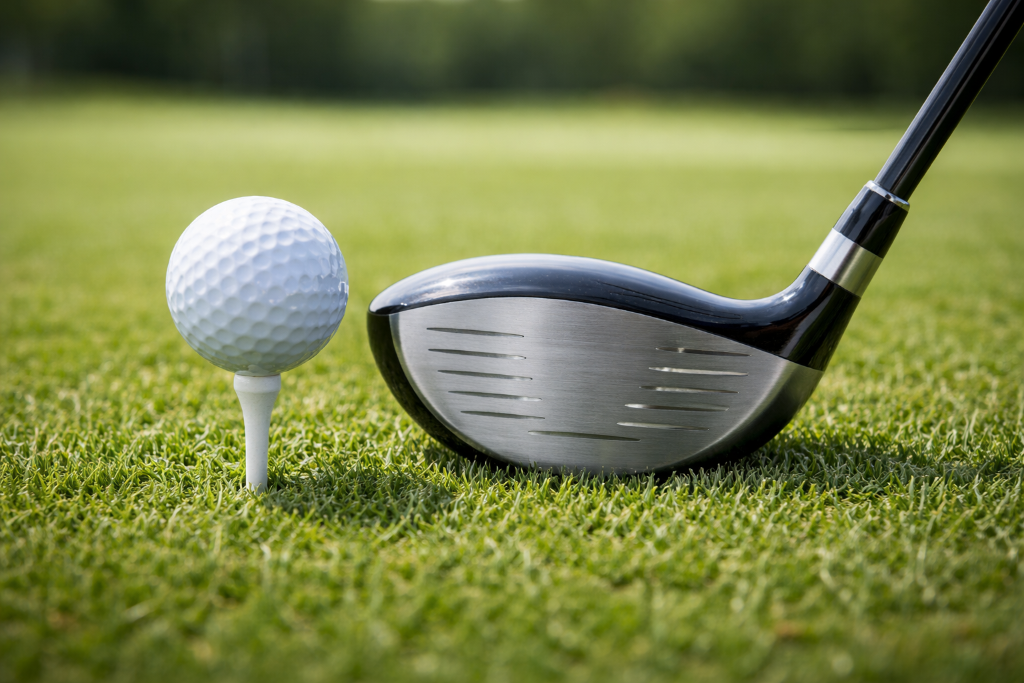
Ball position is one of the simplest adjustments in golf — and one of the most powerful. Where the ball sits in your stance directly influences strike quality, launch angle, spin, and curvature. When ball position is correct, solid contact feels almost automatic. When it is wrong, players often blame their swing.
The key principle is this:
Ball position controls where the club meets the ground — and where it meets the ball.
Understanding that relationship changes everything.
The Center of the Swing Arc
Every golf swing has a low point — the bottom of the arc. With irons and wedges, that low point should occur slightly after the ball. This ensures ball-first contact, followed by turf. With a driver, the low point should occur slightly before the ball, allowing the club to strike the ball on a slight upward path.
Ball position helps determine where that low point happens relative to the ball.
Short Irons and Wedges
With wedges and short irons, the ball should be positioned near the center of your stance, or slightly forward of center.
This setup encourages:
- A downward strike
- Crisp compression
- Controlled launch
- Predictable spin
If the ball creeps too far forward with a wedge, contact becomes shallow. Players often hit thin shots or struggle to control trajectory. If it moves too far back, trajectory lowers excessively and direction can skew right for right-handed players.
A centered position supports consistent distance control — critical in scoring range.
Mid Irons
As clubs get longer — like 6, 7, or 8 irons — ball position shifts slightly forward of center. Not dramatically, but noticeably.
This allows the swing arc to naturally lengthen while still preserving a downward strike. The goal remains ball-first contact, but the angle of attack becomes slightly shallower as loft decreases.
Many mid-iron inconsistencies stem from players leaving the ball too far back, producing overly low shots, or too far forward, producing thin or weak contact.
A gradual forward progression is key.
Long Irons and Hybrids
With long irons and hybrids, the ball should sit farther forward — roughly one to two inches inside the lead heel for most players.
These clubs are designed to launch higher with less loft. The slightly forward position allows:
- A sweeping, but still slightly descending strike
- Improved launch
- Better energy transfer
Too far back, and long irons become difficult to elevate. Too far forward, and solid contact becomes inconsistent.
Hybrids, in particular, benefit from this forward position because they are engineered to glide through turf rather than dig sharply like short irons.
Fairway Woods
Fairway woods should be positioned even farther forward — typically just inside the lead heel.
Unlike irons, fairway woods are designed for a shallow, sweeping motion. The goal is not to hit sharply down, but to brush the turf while delivering clean contact.
Placing the ball too far back with a fairway wood often produces low, skidding shots. Too far forward, and the club may bottom out too early.
The sweet spot lies forward — but not exaggerated.
Driver
The driver is unique. It is the only club in the bag designed to be struck on an upward angle.
The ball should be positioned off the inside of the lead heel, sometimes slightly farther forward depending on stance width. Combined with a slightly wider stance and a subtle spine tilt away from the target, this promotes:
- An upward angle of attack
- Higher launch
- Reduced spin
- Maximum distance
If the driver ball position drifts back, players often hit low, spinning shots or slices. Too far forward, and contact may suffer.
The Progression Principle
Rather than memorizing positions for each club, understand the pattern:
- Short clubs: near center
- Mid irons: slightly forward
- Long clubs: farther forward
- Driver: off the lead heel
Ball position moves progressively forward as club length increases.
Why It Matters
Modern launch monitor data confirms that small changes in ball position can significantly alter angle of attack, launch angle, and spin rate. Players chasing swing fixes often overlook this simple adjustment.
Before changing mechanics, check ball position.
The Takeaway
Ball position is not a guess. It is a structured progression tied to club length and design intent.
When positioned correctly, the club does what it was built to do.
When positioned incorrectly, the swing must compensate.
Control ball position — and you immediately improve contact, flight, and consistency.